I was buckling my seatbelt onboard my Qatar Airways flight from New York’s JFK airport to Doha, Qatar, when I heard the flight attendant over the PA system. She began her welcome in Arabic with the greeting “Assalamu alaikum!” That made me stop what I was doing. Over the past 12 years, I’ve flown internationally to Europe, Africa, the Caribbean, but I’d never heard a flight attendant say “Assalamu Alaikum”.
Although the plane was still on the tarmac, I felt like I was already in a different part of the world. The passengers were mostly people from South Asia and the Middle East. On a flight with mainly American passengers, I suspect this greeting would have raised eyebrows. It might have even caused panic, although many people know that this Arabic greeting means “peace be upon you”; such is the fear that is now prevalent about Muslims in the US. But everyone onboard seemed right at home, and as I glanced around I saw people comfortably settling in for the long, twelve-hour flight. That small incident reminded me that what we call normal is simply what is familiar.
I thought back to all the previous times I had heard the greeting. I’d often heard African muslims use it in the streets of Harlem, New York. In the mid-1990s, I worked in a Manhattan law firm as a paralegal clerk while I attended college. I worked alongside three young African-American men in their twenties, who had recently joined the Nation of Islam. They frequently greeted each other with Assalamu Alaikum, with a kind of bravado and sometimes with glee, loud enough for nearby white colleagues to hear. My white coworkers seemed taken aback. Some seemed scared, while others appeared to be hurt. At the time, I recognized that the white response was not simply because it was associated with Islam, but rather with the Nation of Islam and Minister Farrakhan’s speeches.
Fast forward to late 2015, I was on my way to Al Jazeera Documentary Film Festival, where my film “The Price of Memory” was in competition. I was travelling to the Middle East for the first time. A few hours into my flight, I awakened from my sleep and checked the flight map on my TV screen. I had passed Turkey and was now in between two places I knew from the news: Baghdad and Basra. I remember Basra as the place where five American contractors had been killed publicly a few years ago. A New York tabloid put a photo on its front page with the charred bodies of the contractors, hanging from poles in the street. The headline screamed: SAVAGES. Since then, Basra has been associated with that image in my mind. Of course, most people on earth have seen the bombed out buildings of Baghdad on TV. The map said I was heading towards Shiraz and I couldn’t remember where I had heard of that place, but I suspect it was not for a good reason either. (Later, I would learn from Google that Shiraz is a large city in Iran and one of the oldest in ancient Persia. It is known for poetry and arts. But I had probably only heard of Shiraz from wine.) On the plane, I suddenly panicked for a moment, from the thought that I was flying over a most volatile region. Only a week before, Turkish authorities had shot down a Russian passenger airline. I looked around and people were either eating, sleeping or watching movies. I decided to relax and return to sleep.
My flight landed in Doha the next afternoon. While waiting on line in immigration, I noticed at the left end of the hall, three female immigration officers dressed in black, with their heads covered. All three were sitting at their respective counters, working: conducting interviews, taking photos and stamping approvals in passports. It was a normal immigration scene, except that I had never been anywhere before where female immigration officers covered their heads. It struck me that women dressed like this are frequently stopped in airports in the West. I had seen the familiar discomfort in the faces of other passengers when they saw women in hijab in US airports and also in London. I chuckled inside. Here, this was the norm. In fact, I later saw that the typical Qatari dress for women is a long black dress called an abayha and a black covering over the head called a shayla.
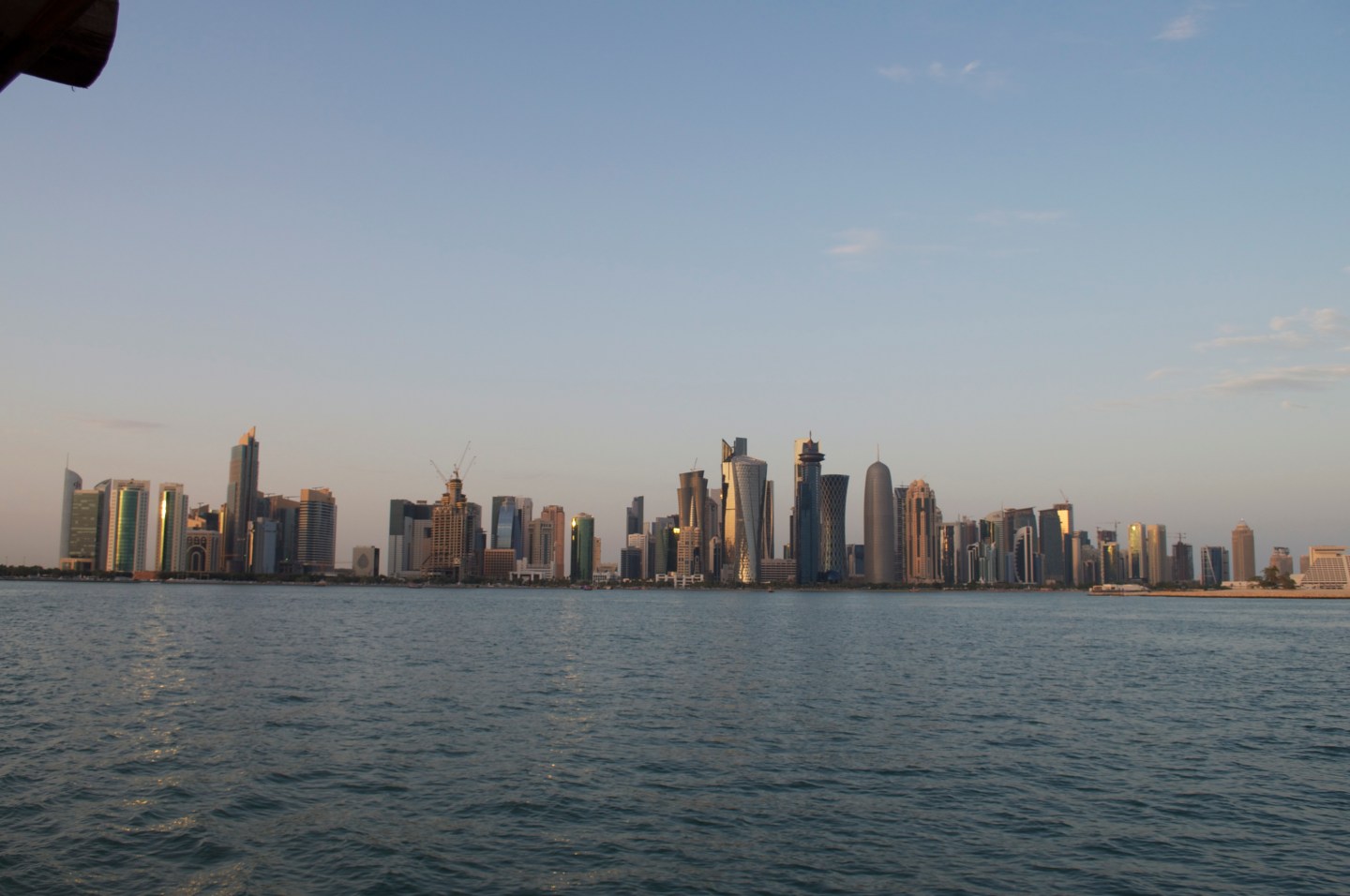
Qatar is a wealthy country ruled by an Emir. The capital, Doha, has a population of two million people with only two hundred thousand who are originally from Qatar; the vast majority of residents are in Qatar to work. They are from other countries in the Middle East and all over the world. At the five star hotel where I stayed as a guest of the festival, I was served by people who were mostly from Asia and Africa and there was the occasional European person at the front desk.
On arrival at my hotel the first evening, a friendly, black girl welcomed me in her late teens to early twenties working with the festival. “Hi, where are you from. I love your hair!” She seemed awed that I was originally from Jamaica. Personally, I felt that I looked awful that day, after almost a full day of travelling, but I smiled. She said that she always wanted to grow dreadlocks like me, but she was afraid she might not like it after it’s done. I said: “It’s hair. If you don’t like it, you can cut it and it will grow back again.” She cringed. The exchange was so simple, but here we were, two black women discussing hair as black women all over the African diaspora discuss hair. I will admit that I was a bit surprised. It had not occurred to me before that a Muslim girl covers her head might also lock her hair. But of course, she could! Both deciding to wear the hair in locks or covering the head, or uncovering each seemed like they could be an act of defiance. The only women I know who cover their locks are Rastafarian women who do not lock it simply for fashion.
On the first day in Doha I went out into the city with a group of filmmakers who I met. The cabdriver who took us back to the hotel told us: “ There is no crime in Doha. This place is very strict. They will cut off your arm if you steal. People just come here to work so they abide by the rules.” Qatar is under Sharia law, i.e. traditional Islamic law. When I asked the Kenyan doorman at the entrance to my hotel. He said with a little laugh: “I have been here six months. Oh, they are strict. They are very strict!” His eyes smiled and said that he had stories that his lips dare not tell.
It is illegal for an unmarried man and woman to share a bedroom in a hotel in Doha. You will not see Qatari women in a lounge where alcohol is served. Yet, I sat among westerners at a bar in my hotel while a young South Asian woman sang Jazz, wearing a shimmering green sleeve-less dress well above her knee. I suppose there are accommodations for non-Muslim Westerners.
Having been assured by several people that nothing could happen to me in Doha, I went out alone on the third day. I felt safe walking as a woman alone, which can be unusual in a new country. I ended up at the Souk, a traditional market. I spent a few hours there wandering through a maze of trinkets, incense burners made in China, fabrics from India and all over the Middle East, shops full of spices, rugs being woven, miniature camels, lamps, pottery from Turkey, tourist items from every corner of Asia and the Middle East. Not once did I feel threatened or unsafe. I was dressed modestly, but my head was uncovered. There were a few western expatriate women wearing jeans and long sleeve shirts, looking like they were in their hometown, comfortably eating and chatting in restaurants. There were very few Muslim women working or selling in the market. Most of the women I encountered, confidently glided rather than walked, in full black from head to toe, with their faces perfectly made up and their heads covered.
Overwhelmingly, the people I encountered in Doha were warm and friendly. People went out of their way to be courteous almost everywhere and I came to see from interacting with people from across the Middle East that it is a region of diverse cultures. I was getting on the elevator with a friendly Muslim woman who had just gotten henna painted on her hand. I said “Very nice”, referring to her hand. She said, “Yes. Thank you. You should do it. It’s free. I just did it for the first time myself” And she told me where to find it at the festival. I expressed surprised that it was her first time. Then she said. “No, I am not used to this, I am Persian. This is Arabic culture. It is so beautiful.” I felt so ignorant.
At the film festival, I attended a panel discussion where the head of Al Jazeera Documentary Channel, addressed producers, most of whom were Arab. He had recently returned from IDFA, an annual film festival held in Amsterdam, which attracts documentary filmmakers and documentary business such as broadcasters, investors and others. It is one of the most important documentary film events in the world. IDFA hosts a Forum where preselected filmmakers pitch their projects in about 8 minutes to commissioning editors representing broadcasters from all over the world, but mostly from Europe and the US. Commissioning Editors are the people who approve and decide to invest the broadcast companies funds in specific projects. It is a marketplace of ideas and this is like the Olympics of pitching.
The Al Jazeera official said that that he noticed an increased interest in the Middle East at IDFA. The majority of pitches were about films to be made in the Middle East. Yet none of those films was being helmed by a person from the Middle East. It was a familiar issue that I had heard many times among African Americans and other African diaspora people, wanting to tell their story but not having the funding. Al Jazeera Documentary and the producers seemed to take it as a call to arms. They wanted more films from producers from the region about the broad spectrum of life from the Middle East.
Yet what was missing from other media outlets, seemed to be the strength of Al Jazeera’s festival. This was the first festival that I had attended of this scale which celebrates films about people from the southern world. The festival had a very strong offering of over a hundred films from around the world, but there was a significant amount of films from and about the Middle East. Within a few short days, I came to see how little I knew about the region and about Islam. I saw a documentary which mentioned that the Golden Dome in Jerusalem is the second most important place in the world to Muslims. Its importance is surpassed only by Mecca. The Golden Dome is the place from which the Prophet Mohamed flew up to heaven on his white horse. This underscores why Muslims view Jerusalem as important and the fact that for them, it is also holy ground.
I also saw an excellent, very creative film called Born in Gaza by Spanish director Hernand Zin. It follows several Palestinian children in Gaza. Through their everyday lives you get a glimpse of what life is like for the children of Gaza. We see children who are experiencing their fathers being killed, a child working to support parents and siblings, a young girl with cancer who can’t travel to get treatment. I had learned from another film that the International Criminal Court, a UN organ, ruled that Israel should tear down the Gaza wall. I haven’t seen that widely discussed in Western media. There is very little coverage of Gaza in the press. It is very unfortunate that Born in Gaza has not been widely seen in the US. It is strange that film of this scope and execution has not been widely available about a subject that is so timely.
I saw a beautiful film from Turkey, Three Thresholds: Birth, Wedding, Death about traditional Turkish customs rituals from birth through death. From watching that film I saw that there were both Christians and muslims and people of other ethnic groups living peacefully in Turkey. There was another short film Om Amira, about a woman in Cairo who sells street food. Her life was nothing short of heroic. It was a simple universal tale of an everyday person, who works hard to feed her family. It would resonate with audiences everywhere, but it’s not the kind of film you would see on western television.
After returning from Qatar to New York, I felt that people who live in Muslim countries must see the newscasts and wonder about what kind of people live in the US. The image of prominent politicians on television routinely spouting hate to appeal to the lowest common denominator is cheap. It makes us look provincial and plain stupid. Yet, the greeting that Muslims use routinely is “Peace be unto you”. In doing business and attending panels discussions and events, I heard “Assalamu alaikum” very often. It was used in a way that made me realize that even people who were not devout muslims at all used this greeting.
The one thing that I took away from meeting so many people from across the Middle East in Qatar is the thing which is absolutely missing in Western media: the diversity of the Middle East. Diversity of cultures, religions, worldviews, approaches to Islam, ethnicity and even in the status of women. You don’t see many films of people in the Middle East that humanize them. The single narrative on US television about the Middle East is about violence. As a result, it is very easy for disingenuous politicians to mislead people who have never seen anything about the Middle East on television except from violence or terrorism.
 Queendom Films
Leave a comment